Daniel Shainberg's newsletter on macroeconomic trends, industry valuations, equity research and other noteworthy relevant financial news without the constantly positive Wall Street spin.
“It would be very surprising to see the market stabilize and take off again from here. What’ happening now is there is a pronounced rise in real long-term interest rates. If you look through history compared to the past 15-20 years that is the key factor that brings the stock market down. Long-term rates are going to rise. We’re moving towards stagflation. That is a toxic mix.”
When asked about leverage, he replied, “leverage is average. The leverage that occurs in the context of a toxic asset is a problem.” The Fed is set to convene its interest-rate setting committee next Tuesday and Wednesday. Investors will closely parse their guidance on the potential for a 4th hike this year as well as any insights into 2019.
When Greenspan, who became famous (or some say infamous) for coining the term “the fed put,” comes clean with a bearish outlook, you know things are dicey!
The mainstream financial news networks prefer to discuss & debate the impact of new & exciting changes. Whether technological innovation or reported growth in corporate America’s eagerly awaited earnings releases, they rely on these headlines
to scroll across the bottom of the television screen to entice your interest and most importantly, your eyeballs. That is how they make money. But what we see being discussed today may not be the right discussion when thinking about the direction of the markets.
Warren Buffett is famous for shunning exciting investment opportunities that may be rife with risk while favoring the old, stodgy, boring businesses that continuously print off cash flows through economic cycles. That type of thinking can
be applied to the financial news. What do we see being discussed today?
• Home-builder confidence & optimism collapsed • Interest rates are spiking • Retailers experiencing a global apocalypse • Inflationary costs & hyper-competitive e-tailers & app developers • Frozen credit markets, specifically leveraged loans post a peak CLO market • Goldman Sachs bankers face criminal charges for the 1MDB scandal • Political unrest in France, problems in Venezuela • Conflicts arising between the U.S. and China, and renewed • Russo / Ukraine tensions
While all of these topics are legitimate elements of concern for the economy, the stock market has an even bigger threat and headwind which is also the likeliest explanation of the volatility we are experiencing today.
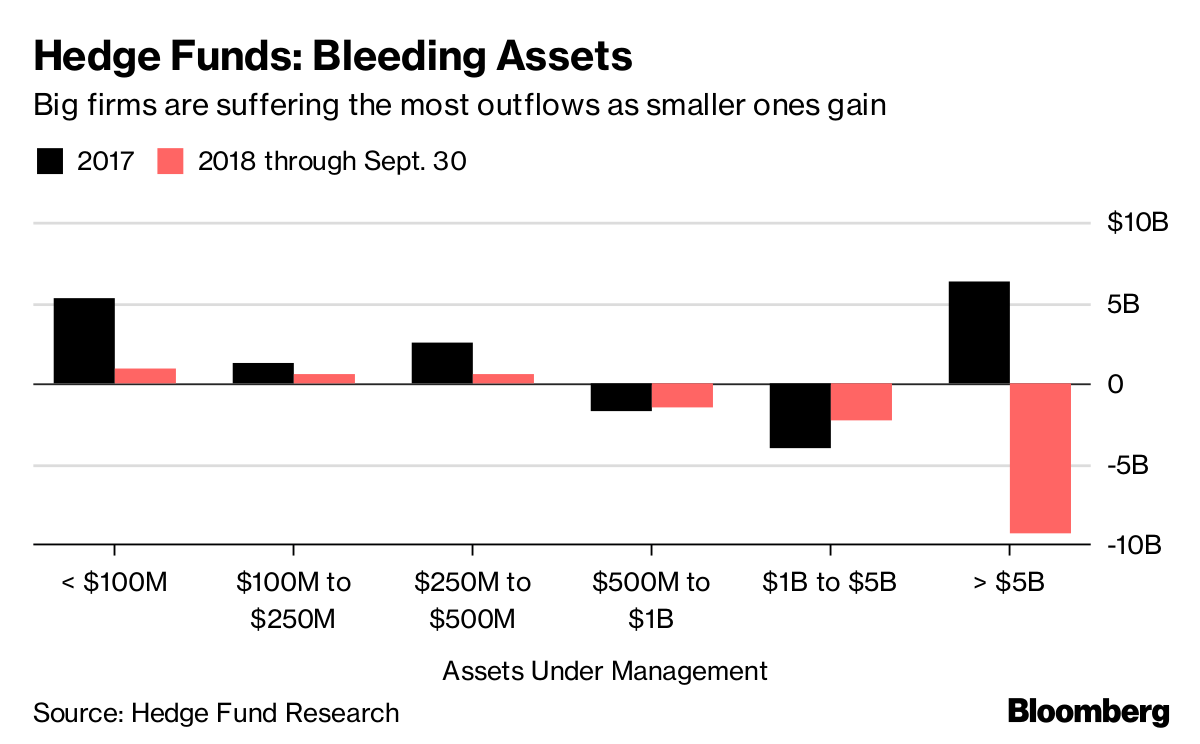
The top 500 hedge funds control ~90% of industry assets according to Preqin research. Hedge Funds control an estimated $2.5 trillion in assets. The market capitalization of the entire S&P 500 is ~$20 trillion. While the market capitalization
of the entire stock market is larger than just this single index, the average daily volume of the all U.S. stocks is ~$75-$125 billion. So comparing hedge fund assets to the average daily volume of stocks, one can see just how massive this ownership class
is relatively speaking. Any forced selling from margin calls or investor redemption requests could unleash a wave of falling dominoes that sends the U.S. equity markets down to 2009 levels, or worse.
The hedge fund industry is highly cyclical and amplified by the use of margin debt to improve returns. Most fund managers invest in the same names as their colleagues in the industry. They cannot mathematically all outperform each other.
Once they start under-performing the indexes, investors flee. That has already began. Investors want uncorrelated opportunities without volatility.
Most hedge fund managers analyze overvalued and over-hyped securities like Tesla and the FANG stocks and pursue short bets against them. They are analytically correct bets. But in the short term, with all of their friends and colleagues
pursuing the same trades, volatility and redemption demands can lead to a multiplier effect working against them. Value is getting crushed by momentum. Overvalued story stocks are generating returns because of short covering. And the potential to create reasonable
risk adjusted returns in the public markets is growing more and more difficult. The good news is that for those investors who have been patiently waiting on the sidelines, their day may come when it becomes time to catch a falling knife and invest in attractive opportunities. It just feels like that day has yet to
come. Wait to see hedge funds blowing up.
According to PIMCO, the economy is “flashing orange,” signaling a recession is near.
The economic cycle does not work that way. There are no hard cut signs that the economy or markets will turn. Volatility can be an initial sign of a turn. So can the yield curve inversion, or a spike in credit defaults, or a widening of the TED spread, or rising unemployment, higher rates, and the list goes on. These economic statistics are backwards looking. To get a sense of the future, once has to understand where we are in the business cycle, the source of recent macro data and a sense as to whether that source can continue feeding the trend.
In 2008 the statistics all looked great. Home prices were rising, new home starts were improving, oil prices were rising from what most perceived as healthy demand and unemployment was low. But what we now know is that the cause of that boom was artificially low interest rate policies set in place by the Greenspan Fed after 9/11. All of the apparently positive market data and statistical reporting on the economy thereafter were simply a reflection of that unsustainable policy. Once rates spiked, the market turned south quickly and the data changed. There was no single truism or “smoking gun” data point that we could have tracked to flash a sign that the crash was starting. It just doesn’t work that way.
PIMCO stated that “the chance of a U.S. downturn of 30% in the next 12 months is at a 9 year high.” This is nonsense. Pimco economist Joachim Fels and Andrew Balls, global fixed-income chief investment officer, wrote in an outlook, “the models are flashing orange rather than red.” They certainly might prove to be right but where does this 30% likelihood come from? Past examples? There are no perfect correlations to this decade long bull run of multiple rounds of QE. Add in the rise of Asia and related tariff threats plus technological advances. There is just no way to create a statistical model that can accurately input all of these real world situations and model out some color threat. It’s almost as ridiculous as the government’s color based threat list implemented after 9/11. Even they scrapped the use of that type of indicator.
In an instant we could hear news of softening rhetoric with regards to Chinese U.S. relations like we saw with North Korea. We could have the Fed announce a pause in their rate hiking trend, a prognostication that many Fed watchers believe is likely. We could see the benefits of the recent decline in oil prices follow through to consumer spending, the most impactful segment of the U.S. economy.
While this newsletter is dedicated to our bearish outlook for the markets, we will call out headlines such as the one in today’s PIMCO report that is clouded with eccentricity and unsubstantiated fear-based marketing.
Dan Shainberg December 5, 2018 While our newsletter has been calling for a recession and market decline for months now, and we finally got a big one, today's newsletter will instead focus on what the pundits are not talking about. It's easy to point to the popular news de jour and try to make a correlation. China, the Fed or a large tech company's fiscal report sound like they could be reasons for the equity markets to react. But when you see 700-800 basis points of index erosion in a single day, I would argue that you are better off analyzing the bond markets to induce an explanation, not CNN or CNBC. When looking at the bond markets, we see a nuanced yet meaningful change. The "yield curve" is one of the most followed graphs that credit investors track. It charts the yields offered from government bonds of varying maturities. Traditionally, the yield curve displays an upward sloping pattern as inflation expectations warrant higher returns for fixed income investors willing to part with their capital for a longer time. But when the yield curve inverts, or flips to a pattern where shorter term bonds offer higher yields than its longer term counterparts, that is an uncommon pattern and a signal for concern in the macro-economy and equity markets. "Jeffrey Gundlach, CEO of DoubleLine Capital, says the U.S. Treasury yield curve inversion on short end maturities are signaling that the economy is poised to weaken.” The inversion occurs because investors bid up the prices of longer term bonds as they anticipate risk in the economy and markets. Traditionally bonds are less volatile than equities, so if you are a pension fund manager, and expect significant volatility in the coming years, you will shift your allocation to bonds. This increased demand causes the price to rise and commensurate yield to shrink. The short end however remains elevated or may even experience higher yields because those investors concerned about the future don't want to hide in the bond markets for a few months or years. What would happen when those short term bonds mature? If their bearish inclinations are correct, they would have to reallocate maturing debt proceeds into lower yielding bonds or declining equities. So they prefer to lock into long term debt driving up its price. However, if the Fed hikes short term rates, like they are now, to tighten the monetary supply and reign in inflationary risks, then the short term bond market will see rising rates. The combination of rising short term rates and declining long term rates can cause the yield curve to invert. Right now, the yield curve has flattened out and is starting to invert. It is a classic signal that the bond market, often referred to as the "smart money," is signalling to investors that the current expansion phase of the economy is nearing its end and may soon turn into a recession. It's impossible to accurately explain short term movements in the equity markets. But if one had to guess, I'd choose the bond market's yield curve inversion as the main culprit for yesterday's sharp equity market selloff over China or Trump or the Fed.
Daniel Shainberg November 23, 2018 Where have I been these past few weeks? There is a famous quote "It's better to shut up and give the impression that you're stupid than to say something and erase all doubt." Over the past few weeks we have seen many of our bearish calls prove accurate dating to the beginning of this newsletter just a few months ago. At the time, the markets were hot, Trump was taking credit for the stock market's performance, indexes were inching higher daily, equities were trading devoid of valuation and bitcoin bros were a thing. Now that seems to have all reversed. Stock market investors are nervously asking "what's next?" The bitcoin bulls have gone into hibernation. Real estate brokers, builder and bankers are wondering why their businesses have slowed. The spot price of oil has finally caught up with its depressed futures curve. Boeing's shares have plummeted, as we have predicted, and overvalued tech companies have seen their valuations come crashing back to earth. Credit spreads and rates are blowing out. When volatility spikes you simply cannot predict the daily moves. On Thanksgiving eve the equity markets rallied after its bearish performance over the prior week only to give back all its gains into the close. As we have said numerous times before, you cannot predict the short term movement of the stock market accurately. But you can certainly safeguard your assets from significant downturns by taking a longer term view and focusing on valuation metrics. I recently read a bullish posting on Boeing (BA), a company we have been bearishly inclined over the past few months, even before its stock price downturn. The bullish article pointed to their 8% Free Cash Flow yield and duopoly status in the aerospace sector. What the article failed to mention is that there free cash flow is not a rock solid figure. It can change. It is fluid. Their valuation implies an 8% yield on their current free cash flow. But their business is a mix of commercial Aerospace and Defense contracts. On the Aerospace side of the business they have experienced a temporary boom from cheap global credit and inflationary domestic spending in China (and India). That growth bulge in middle income consumers in the emerging markets led to a temporary boom in orders. But the aerospace sector, like the emerging markets sector, is very cyclical. Once that downturn occurs, the supply and demand balance for these aircraft could plummet, sending Boeing's Aerospace segment cash flow cratering down along with it. And their Defense business is ~1/3 of their total EBITDA. This is a business essentially with 1 key customer - the U.S. Government. And the outlook for that business over the next few years is even uglier. Sure the government has been spending without a care in the world, running over a trillion dollars deficits annually. But we now have well over $20 trillion in federal debt and our national credit metrics are approaching junk status. Defense spending is the largest expenditure of the U.S. government by an overwhelming degree. It is also the easiest to cut in a downturn. And given the national security implications involved, the U.S. government can also restrict Boeing from selling their products internationally. This is a business and sector that used to trade at 10x earnings, and is now trading at or above 20x earnings. And the earnings are inflate. When their earnings start crashing, their over-inflated multiple will as well. All their investors who have been attracted to their dividend yield will ask why they overpaid for the yield when competing rates offer larger returns with lower risk. Investors in Boeing, like their risk friendly equity investors in momentum driven tech stocks and other inflated asset classes will start blaming everyone but themselves. Even President Trump stopped taking credit for the stock market performance and started pointing fingers, most recently at Steve Mnuchin. "Trump is blaming Mnuchin for picking Jerome Powell to lead the Federal Reserve. Powell isn't very popular in the West Wing right now, as Trump has made abundantly clear with his repeated attacks on the Fed. Trump has blamed Powell for insisting on raising interest rates, and even hinted at times that he could be open to making a change at the central bank, something that has evoked nothing short of abject horror on Wall Street."
Rising rates can be a sign of a strong economy if they are rising due to inflationary pressures, or a weak economy if they are rising because of a change to the supply and demand of credit. When the economy is flush with cash, lending activity increases, and investors scramble into deals where traditional credit risk metrics may be ignored. When the economic outlook sours, the relative demand for capital increases while the supply demands higher risk premiums, the combined effect of which is an increase in overall rates and/or spreads.
There is almost universal agreement today, with unemployment at record lows and wage inflation soaring, that the rising rate environment is due to a strong economy. The Fed is increasing rates and credit spreads remain extremely tight. But if the Fed artificially raises rates, will the collapse the economy? Or is it simply going to serve as a GDP headwind, allowing for continued softer growth rates while reigning in the associated undesirable inflationary impacts?
“Further rate hikes will spark next stock market crash”, Peter Schiff warns, but without much substance. The perma-bear is probably right, but why? Why is he so convinced that rising rates will turn the economy into the Great Depression instead of triggering a soft landing where inflation and growth rates rest in a healthy balance?
The key culprits for financial crises is leverage. The last crisis in 2008 was primarily ignited in the banking sector, although the government certainly held a heap of blame. Today, the banking sector is much more regulated and healthy, although the shadow-banking sector is always a risk given more limited oversight. But the central banking and corporate sector debt is inflated. There is no doubt that should a similar ignition be lit in either of these sectors, the contagion could very well grow to be materially worse to the economy than that of the recession from a decade ago. In the next crises, there won’t be a central bank band-aid like we saw in the aftermath of the Great Recession.
We don’t know what will cause the ignition for the next financial crises, but a betting person would have to seriously consider that the next big one could be started by the likelihood for runaway inflation over the next 1-2 fiscal quarters. We are already seeing signs from Q3 2018 that the Fed’s 2% target for the CPI materially discounts true inflation which can be 3x greater when you actually read the statements from corporate America. As inflation whips up, interest rates will have to rise, and if they risk into a spike, which is likely, the “soft-landing” will not happen.
Just a few newsletters ago we warned of the risk inherent in Boeing’s market capitalization.
The Aerospace & Defense sector has seen valuations for the sector rise without a corresponding growth in cash flows over the past decade. Lockheed Martin (LMT) traded at 10x FCF with a 5% dividend yield, and today it trades for roughly twice the valuation despite minimal growth in annual profitability over the past 10 years. Boeing (BA) has seen more growth given its higher relative exposure to true aerospace customers; however, they are still trading at eye-popping valuations on current cash flows, and an insanely expensive valuation when factoring in its historical cyclicality.
Given its exposure to the commercial aerospace sector, Boeing has rode the emerging markets wave up, but they will eventually ride it down too. We noted the elevated valuations and how investors were stretching for yield in what has always been a defensive, dividend paying, liquid sector.
We also noted that the inflationary trends from the Defense sector from the past 5-10 decades are unlikely to persist given the obvious mathematical dilemmas that occur when the government reduces tax receipts and increases its debts and deficit at the peak of the economic cycle while interest rates skyrocket higher. At some point the math just doesn’t work. Now, the news of today that sent Boeing (BA) down >8% wiping 150bps off the Dow along with it is entirely unrelated to our bearish long-term thesis. They spent a ton of capital to develop a new plane. The plane crashed. It was a brand new Boeing 737 MAX 8 jet operated by Lion Air. Now the market is baking in a slight possibility that there are serious costs to retool and fix manufacturing problems and/or 1-time litigation payments.
The market is also incorporating the risks that tariffs could threaten their growth rates given they export 80% of what they build and 90% is built domestically.
This could easily be a pre-cursor for a long term Boeing bear market. Ultimately investors in Boeing need to incorporating the risk of a dividend cut. When you have 1 major customer (the U.S. government), and that customer cannot pay you and also can legally restrict you from selling your products to others, that becomes a major problem. When you combine that with a cyclical decline in the emerging markets, which historically have been the most volatile geographic sector of the macro-economy, that becomes the recipe for GE style dividend cuts. Savers who bid up BA shares over the past decade assuming they are a bellwether, nifty-fifty name will be shocked just like GE shareholders were in 2018.